

The public transport sector faces a recurring challenge: the “perpetual pilot syndrome.”
Dozens of Demand-Responsive Transport schemes launch on the back of temporary innovation grants or one-off subsidies, run for a few months across a microscopic footprint, report impressive headline metrics, and vanish the moment the funding runs out. Transit authorities struggle to justify long-term budget commitments, and local communities are left unserved once again.
Breaking away from this pattern, the Sud Salento DRT service in Apulia, Italy, offers a clear counter-precedent: how to transition a hyper-local, short-term pilot into an enduring, multi-municipal public transit network backed by a standard public procurement contract.

1. The Starting Point: Moving Beyond a Local Pilot
The project originally launched with a narrow mandate in the Capo di Leuca area: a National Recovery and Resilience Plan (NRRP) grant targeted exclusively at the municipality of Patù. It deployed a single 8-seater vehicle operating 12 daily runs to link the town centre with coastal marinas.
Typically, such initiatives expire when the summer season wraps up. Here, however, local authorities and technical planners treated the project not as a standalone tech showcase, but as an empirical demand-validation phase:
- Strict municipal borders forced residents back into private cars whenever trips crossed into adjacent towns.
- Extreme seasonality clogged coastal roads in August, while leaving inland villages stranded during off-peak months.
- Service data revealed that low ridership was not caused by a lack of citizen interest, but by inadequate territorial scale and fragmented inter-municipal governance.
Determining whether a territory holds the critical mass needed to make that transition—and forecasting real-world travel demand before deploying rolling stock—is what separates temporary trials from sustainable transit networks.
2. Scaling Up: Sud Salento DRT 11 Municipalities and a Public Procurement Milestone
The decisive turning point was not just technology, but establishing the cross-jurisdictional governance and contractual foundation required to operationalise the model enabled by Nemi’s software.
Through the Unione dei Comuni Terra di Leuca, the service expanded beyond a single town council to operate as an integrated network across 11 municipalities (Alessano, Corsano, Gagliano del Capo, Morciano di Leuca, Salve, Tiggiano, Patù, Castrignano del Capo, Specchia, Miggiano, and Montesano Salentino).
This scale shift marked a major procurement milestone in the Italian market: the first long-term contract for a DRT platform of this scope and volume awarded by a public authority through standard, open public tender.
The scheme progressed from temporary grant dependency into regional transport spending and territorial cohesion budgets, structured as a two-tier hybrid operational model:
- LineaTAD: Predictable, semi-fixed trunk corridors connecting regional hubs and transit interchanges.
- FlexiTAD: Area-wide on-demand coverage (5 operational zones served by 23-seat minibuses) penetrating lower-density settlements only when an active booking is logged.
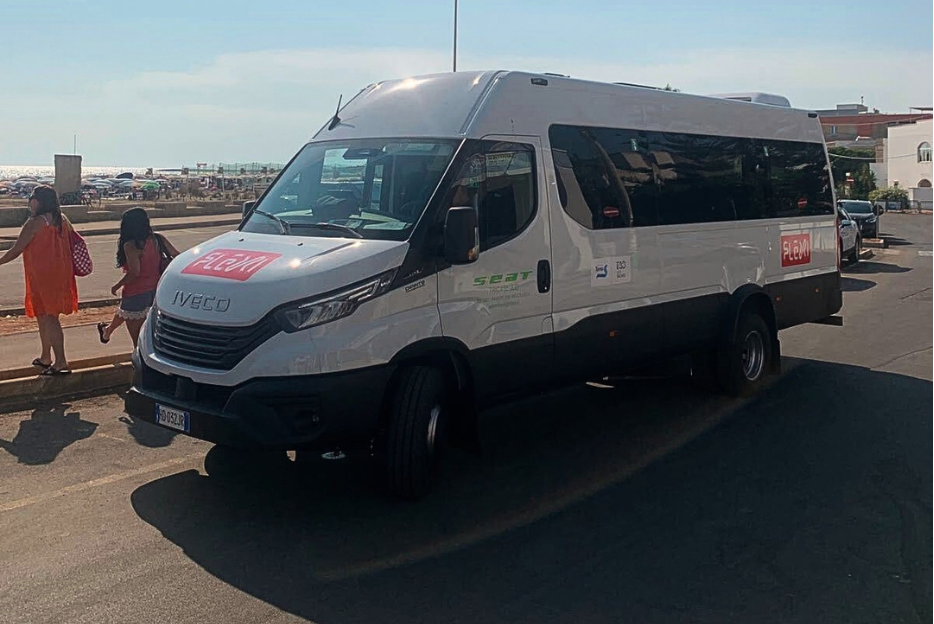
3. From Peak Summer Surges to Autumn Everyday Mobility
Coastal areas frequently face an operational trade-off: sizing fleets to absorb July and August visitor surges creates unsustainable cost overheads in winter, while cutting lines in September leaves local residents exposed to transport poverty.
To break this cycle, Sud Salento launched on August 5 with a phased, organic rollout without paid ad campaigns. Within its first month, key performance indicators confirmed system viability:
- 3,060 organic app downloads during the launch month.
- 3.12 average passengers per trip, proving effective pooling and routing efficiency.
- 77 registered Passengers with Reduced Mobility (PRM), ensuring accessible transit compliance.
- 90% user satisfaction across comfort and app usability.

4. Three Strategic Lessons for Transport Authorities and Operators
The Sud Salento deployment outlines a clear roadmap for transit planners and public authorities:
- Cross-municipal scale is the minimum viability threshold: Isolated municipal DRT systems struggle with operational efficiency if they do not link into regional transit hubs and neighbouring rail links. Joint municipal consortia pool fixed overheads and significantly raise vehicle occupancy rates.
- Pilot metrics must feed directly into formal tender specs: Trial phases must capture empirical cost-per-kilometre data, actual wait times, and origin-destination matrices. Armed with reliable data, standard public procurement ceases to be a speculative bet and becomes an evidence-based technical specification with contained risk.
- DRT complements and safeguards fixed networks: Running standard, empty 12-metre buses through sparse rural corridors drains operating margins. Replacing low-yield, fixed-route runs with dynamic, demand-responsive services preserves municipal budgets without stripping communities of essential transit access.