
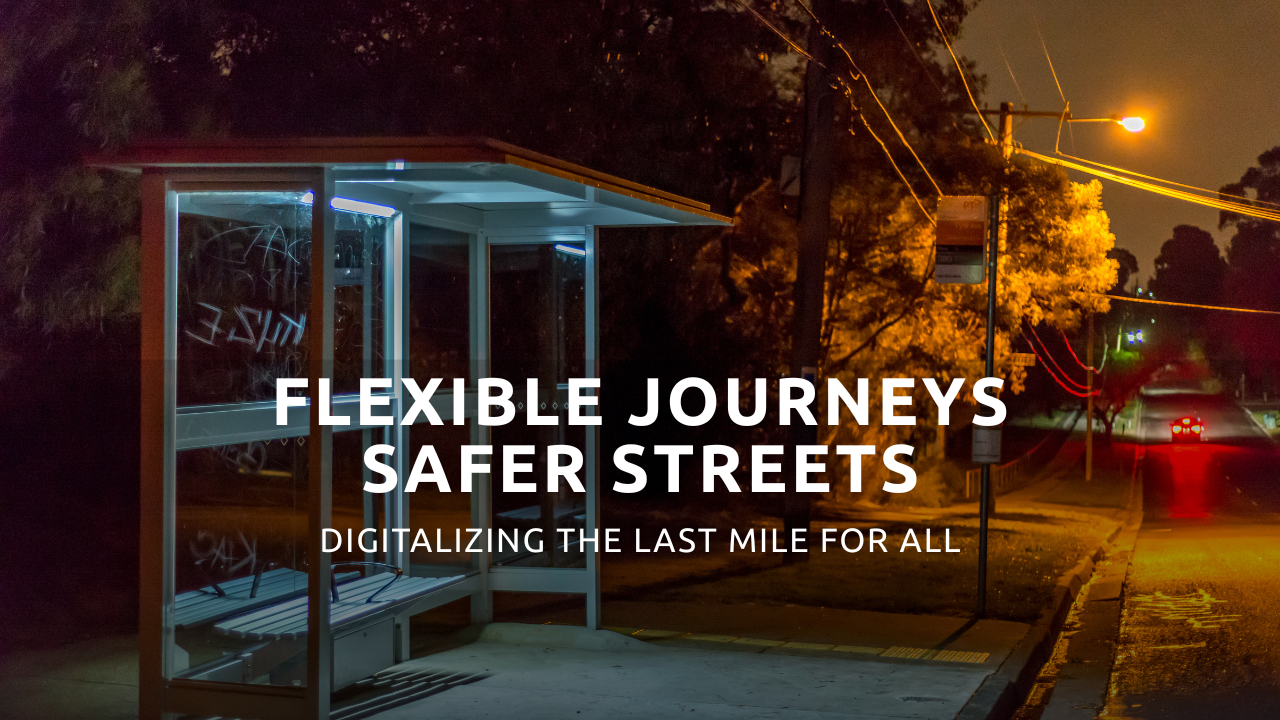
Urban mobility does not affect everyone equally. When the sun goes down, travel dynamics shift drastically, and night-time transport becomes a critical pain point for urban safety.
For many passengers, especially young women, the journey does not end when they step off the bus. The real challenge begins during the final stretch: that last walk from the stop to their front door. This vulnerability is not just a matter of perception; it translates into real behavioral changes, longer routes, and a constant sense of insecurity.
How can we design public transport that responds to these realities? The answer does not lie in crowding rigid routes with more buses, but in making technology more flexible. This is precisely where Demand-Responsive Transport (DRT) establishes itself as a real, viable alternative working as a Pillar of Inclusive and Safe Mobility.
What Does the DRT Model Bring to Night-Time Safety?
DRT breaks away from the rigidity of traditional routes to adapt to actual night-time demand. By implementing advanced technological tools like NEMI, the service gains key features dedicated to user protection:
-
Flexibility at Stops: Vehicles can combine the structure of a regular line with the flexibility to detour or pull over at points much closer to the user’s destination, drastically reducing walking distances.
-
Proactive Safety: Integration of safety features like a “purple button” or emergency button within the mobile app allows for immediate connection with emergency services under clear operational protocols.
-
Real-Time Traceability: Offers total tracking of the journey for both the operator and the passenger, exponentially increasing the perception of control and safety.
Two Real-World Approaches: Lessons from the Costa Brava and Vitoria-Gasteiz
The theory behind DRT is flawless, but its true value is proven on the streets. By analyzing two recent deployments, we can extract fundamental lessons on how to execute these projects successfully.

1. The Costa Brava Case: The Challenge of Change Management and Occasional User Adoption
The pilot project implemented in the Costa Brava region alongside operators Sarfa and Teisa served as an excellent testing ground to evaluate DRT behavior integrated with the NEMI technology platform in a highly complex environment. The service was designed as a night bus with on-demand stops and flexible routing, aiming to maximize passenger safety and optimize operational flexibility.
The context presented unique challenges: a heavily tourist-oriented environment, massive fluctuations in demand, and, above all, a high volume of users who were strictly occasional rather than recurring.
On a purely technical level, the technology performed flawlessly, proving the viability of digitalizing stops and generating dynamic routes in real time. However, the pilot ran directly into critical barriers regarding the operational and social dimensions: communication, effective service activation, and public access channels.
This experience provided a fundamental lesson for the Smart Cities sector: the success of an intelligent mobility ecosystem does not rely solely on technological deployment, but on the adoption strategy and proper change management. In tourist or nightlife areas, users will not tolerate steep learning curves or lengthy, complex registration processes.
Key Takeaway:
To make the DRT model viable for non-recurring passenger flows, friction must be reduced to an absolute minimum. This means deploying instant, intuitive, and everyday booking channels like a WhatsApp bot. At the same time, the service’s message must be clear from the first touchpoint, organically integrating it into the region’s leisure and tourism ecosystem. The core design premise must be unanimous: conceive the service entirely from the perspective of the casual user.
2. The Vitoria-Gasteiz Case: The Power of Public Policy and Structural Integration
At the opposite end of the implementation strategy sits the case of Vitoria-Gasteiz through its public operator, TUVISA. In this scenario, the introduction of night-time on-demand stops specifically geared toward protecting women and minors (branded under the Paradas Morea or “Purple Stops” model) was not approached as an isolated experiment, a temporary patch, or a short-lived pilot. The secret to its impact lay in its conception as a structural transformation, fully integrated into the city’s standard night-time transport operations.
This public management approach offers a core lesson for modern urban planning: when inclusive mobility solutions with a gender perspective cease to be mere urban laboratory trials and are firmly adopted as structural public policies, the environment’s behavior changes entirely. Integration into regular, everyday lines normalizes the use of the technology among citizens, exponentially multiplies user trust in the system, and grants full institutional and social legitimacy to the service.
To operationalize such an ambitious public policy model, advanced digitalization is the only viable path. Through specialized software tools like NEMI, the transport network can manage the digitalization of these on-demand stops, turning them into dynamically generated routes that optimize fleet resources.
Key Takeaway:
Real impact is achieved when inclusive mobility ceases to be a short-term trial and becomes permanent public policy. Integrating these solutions into everyday operations normalizes the technology, builds absolute user trust, and secures institutional legitimacy.
Beyond Technology: Moving Toward a Mandatory Standard for Safety and Digitalization
The success of mobility with a gender perspective does not depend solely on having an excellent algorithm that optimizes routes in real time. Technology is the enabler, the engine that makes the model viable, but the true impact is achieved when that tool is placed at the service of an integrated public safety system. Designing safer cities inevitably requires designing more flexible, connected, and human-centric public transport.
This approach is no longer just a best-practice recommendation for urban design or corporate social responsibility; it is rapidly becoming a mandatory legal imperative for companies in the sector.
A clear example of this paradigm shift can be found in Catalonia with the recent entry into force of Decret Llei 5/2026. This new regulation accelerates the digital transformation of intercity transport by strictly requiring transport operators to implement advanced Operations Support Systems capable of offering real-time positioning and arrival predictions.
Additionally, the decree mandates automated, digital communication with the Mobility Management and Information Center (CGIM) under open standards such as GTFS and SIRI, ensuring that the end-user has accurate, accessible, and transparent information before and during their journey.

Digitalization of Intercity Lines
The most significant aspect of this regulatory framework is that it directly links technological excellence with safety and equality, explicitly demanding the application of protocols against sexual violence within transport plans. With rigorous execution deadlines that mandate operational systems within a maximum of 8 months from the approval of the action plans, the legislation makes it clear that digitalization is no longer an optional extra in a tender, but a structural requirement to guarantee the continuity and legitimacy of public transport concessions.
Technology and the law are moving in the same direction. Flexible platforms like NEMI prove that it is possible to respond to these regulatory demands for data automation and integration with systems like T-Mobilitat, while simultaneously operating dynamic services that protect the most vulnerable groups. Complying with the law is no longer just a matter of passing a technical audit; it is an opportunity to build a public infrastructure where the right to safe mobility is an everyday reality for everyone. With this new Decret Llei, Catalonia is firmly stepping up its mobility standards.
Making Demand-Responsive Transport (DRT) work as a Pillar of Inclusive and Safe Mobility could be challenging, and navigating these new legal requirements could feel like a hurdle. At NEMI, we are already helping transport networks integrate these advanced systems smoothly. Let’s build a safer, fully compliant mobility model together, so reach out to our team today for a consultation.